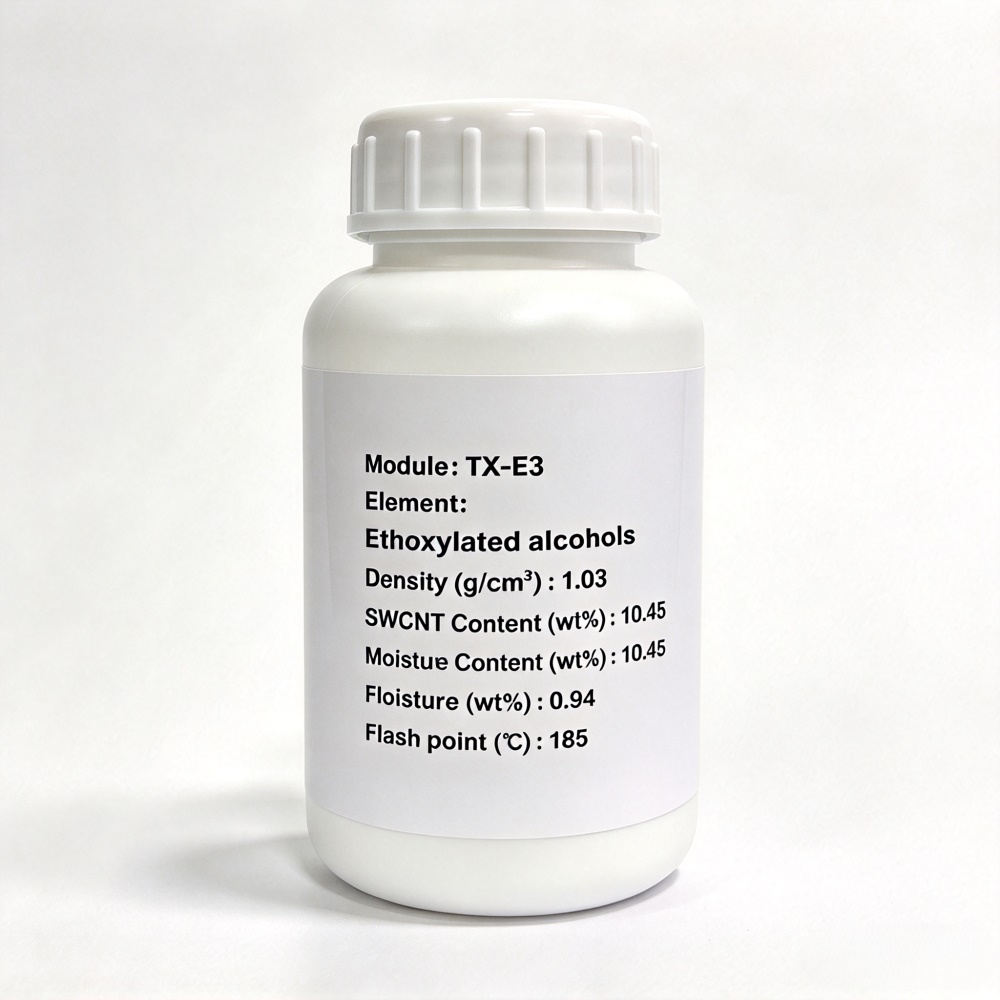
TX-E3 is a single-walled carbon nanotube (SWCNT) pre-dispersed concentrated material independently developed and produced by Shandong Carbon Search. It can be diluted and directly added to various resin systems for use.
This product imparts good conductivity at low loadings, with minimal impact on the resin's rheology, mechanical properties, and original color.
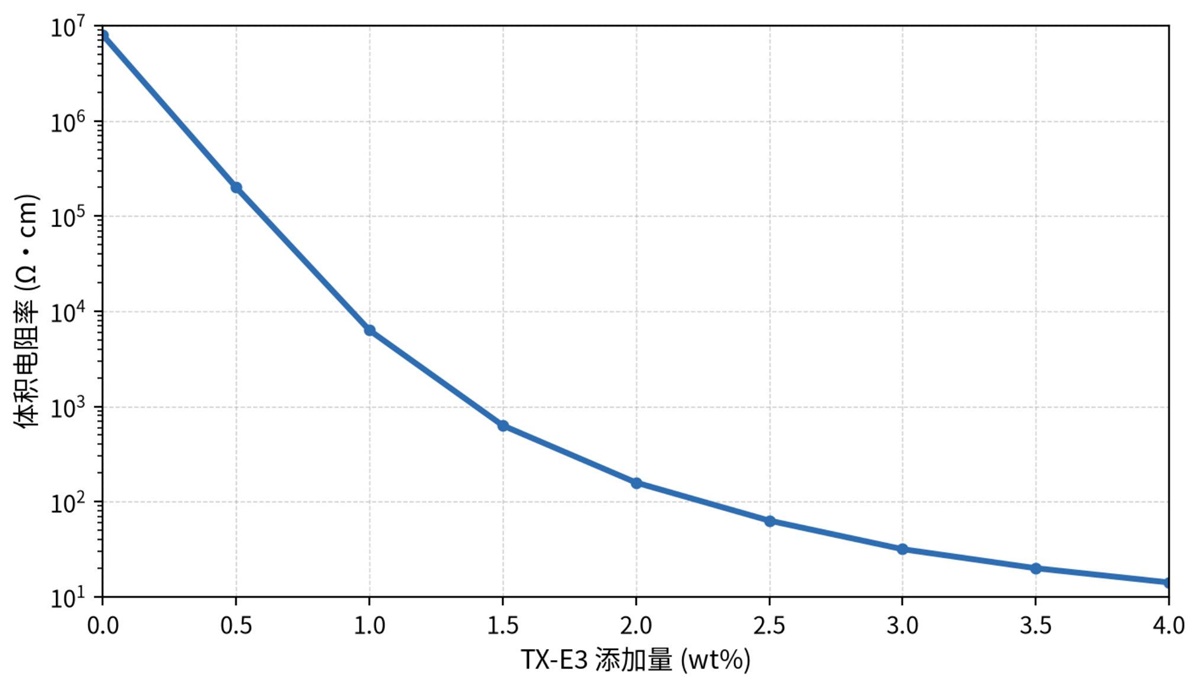
TX-E3 targets conductive modification of epoxy systems, enabling tunable volume resistivity of 10²–10⁸ Ω·cm depending on blending ratio, processing, and formulation.
Product Specification Parameters
| Index |
Measured values |
| Element |
Ethoxylated alcohols |
| Density (g/cm³) |
1.03 |
| SWCNT Content (wt%) |
10.45 |
| Moisture (wt%) |
0.94 |
| Flash point (℃) |
185 |
Note: The above are typical laboratory test values, and reasonable process fluctuations may exist between different batches of the product.
Dosing guide
Figure 1 plots volume resistivity vs. TX-E3 loading in D.E.R.351 epoxy, providing a dosage reference for formulation development. Actual loading requirements may shift with resin grade and filler system, so experimental verification is required.
Filler system note: With fibers or inorganic fillers present, calculate TX-E3 dosage based on resin phase fraction. Example: 50/50 wt% resin/fiber targeting 10⁴ Ω·cm overall → ~0.5 wt% total TX-E3, i.e. 1.0 wt% in the resin phase. Verify experimentally.
Processing and Dispersion Guidelines
Dispersion uniformity directly determines final conductivity, making the dilution process critical. A two-step dilution is recommended:
① Pre-dispersion: Mix TX-E3 with part of the resin at 2–5 wt% concentrate loading.
② Final dilution: Add remaining resin to reach target loading (see Figure 1 for
estimation; verify experimentally).
Dilution Equipment and Mixing Parameters
A flat-bottomed cylindrical mixing vessel is recommended for dilution. Mixing time should be adjusted based on batch size and material rheology. Reference parameters: main mixing at 1000 rpm for ≥15 min, then reduce to 100 rpm for 5 min for defoaming.
Regularly inspect the impeller, walls, and bottom for adhered, poorly dispersed material. Quick check: spread a thin sample on white paper — no visible black agglomerates means acceptable dispersion; otherwise, extend mixing.
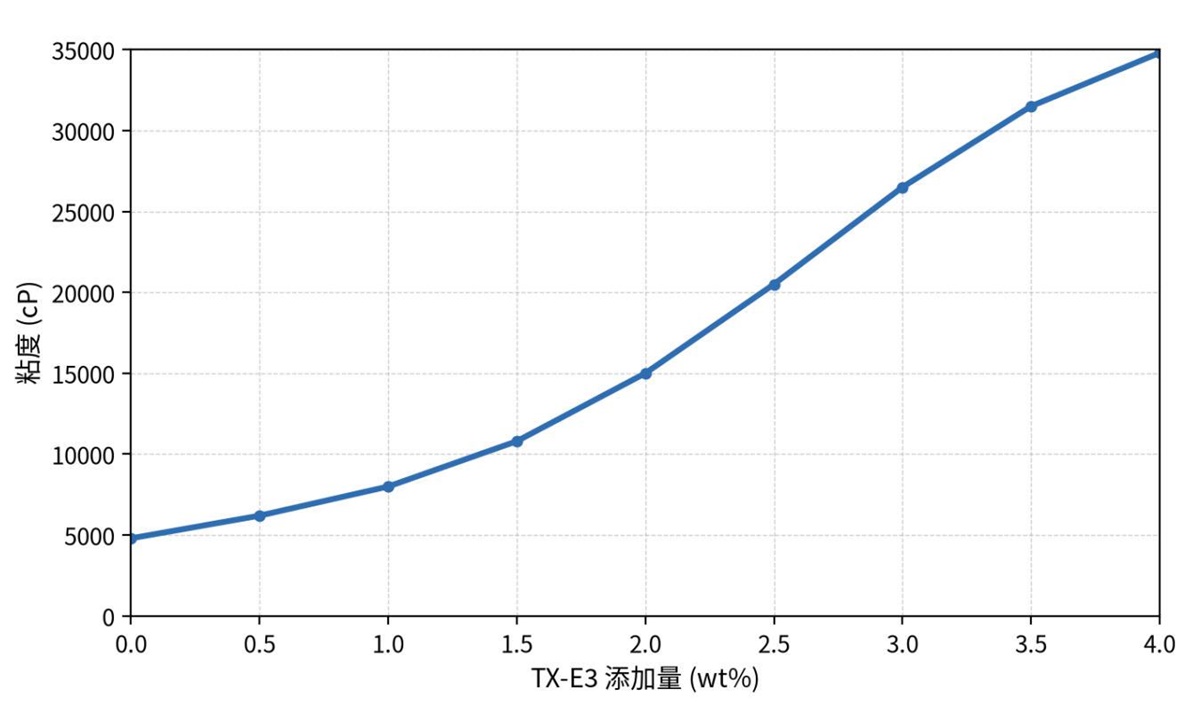
Even low loadings raise viscosity (see Figure 2). Adjust temperature, mixing time, and speed to improve homogeneity; use a viscosity modifier if needed.
Figure 2 Viscosity of D.E.R.351 epoxy vs. TX-E3 loading
Test conditions: 25 °C, Brookfield, SC4-6 spindle, 20 rpm, ASTM D2983. Typical values for this resin system only.
Dilution Equipment and Mixing Parameters
• Lab-scale: 2000 rpm mechanical stirrer (e.g., Heidolph RZR, IKA Eurostar).
• Industrial scale: DISPERMAT CA series.
• Use high-shear dispersion blades for enhanced shear dispersion.
After dilution, add remaining components. CNTs tend to re-agglomerate in thermosetting resins during storage, so mix in the curing agent and cure promptly after dilution. Shelf life must be determined by stability testing for each formulation.
Storage Conditions
Store per domestic chemical material regulations. Keep in original sealed containers at ≤70 °C, away from direct sunlight, in a dry, ventilated, cool area; keep away from strong oxidizers, strong bases, incompatible materials, food, and beverages. Keep containers closed when not in use; reseal and store upright after opening to prevent leakage. Do not transfer to unlabeled containers. Manage
storage properly to prevent environmental leakage. Shelf life: 6 months in original sealed containers.
Safety Precautions
TX-E3 is a viscous paste with CNTs encapsulated in a carrier system. Follow concentrated chemical handling regulations during transfer and on-site operations.
Read the accompanying MSDS before use and implement appropriate protective measures.
Disclaimer
This data sheet is based on Shandong Carbon Search's internal test data and is for formulation reference only. As actual application conditions are beyond our control, no express or implied warranties are made for results from direct use of these parameters. Customers must verify suitability for their own processes and formulations. The product is provided "as is," with all implied warranties excluded to the maximum extent permitted by law.
 +86 155 5799 4552
 info@carbon-tx.com
 Blue Carbon Neutral Industrial Park,Tai'an City, Shandong Province,China



 Contact

 English
 Chinese

