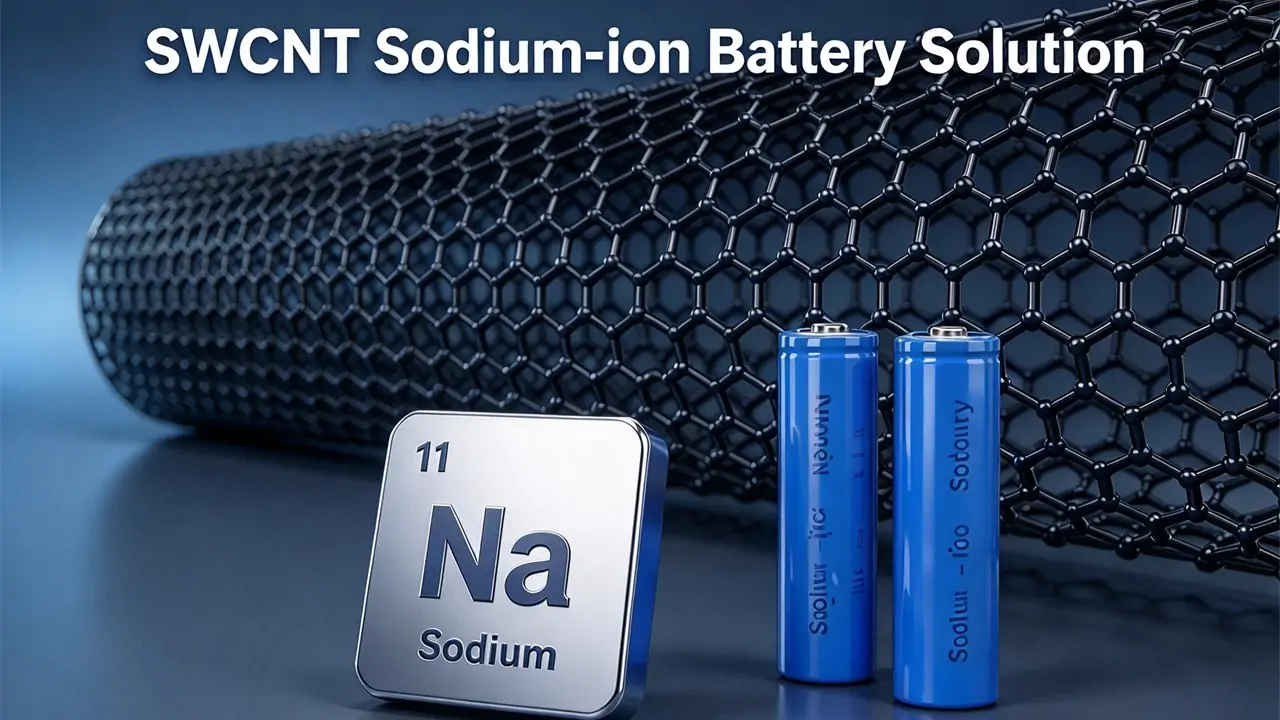
Prussian Blue Cathode + SWCNT Reinforced Hard Carbon Anode, Superior Rate, Low-temperature & Pulse Discharge Performance.Ultra-low loading SWCNT conductive network, empower sodium-ion battery for fast charging, low-temperature and high-power pulse output.
Sodium-ion battery is a promising electrochemical energy storage system benefiting from abundant raw material resources, widely applied in energy storage, low-speed mobility and backup power. However, hard carbon anodes normally suffer from poor intrinsic conductivity, severe polarization at low temperature, large voltage drop under high-current pulse and limited rate capability. Prussian blue cathode also faces sluggish ion transport, restricting its deployment for high-power and wide-temperature scenarios.
Our solution adopts single-walled carbon nanotubes (SWCNT) as nano conductive modifier in hard carbon anode, matched with Prussian blue cathode. Thanks to ultra-high aspect ratio, dispersed SWCNTs build a continuous 3D long-range conductive network among hard carbon particles, reducing electrode internal resistance and accelerating charge transfer. It greatly improves room-temperature rate discharge, low-temperature capacity retention and voltage stability under high-current pulse, mitigating voltage sag and capacity fading of sodium-ion batteries under high-power & cold conditions.
Core Advantages
✅ Enhanced rate discharge performance at 25℃ (1C) Lower polarization and higher discharge plateau at identical C-rate, realizing full capacity release, outperforming reference competitors.
✅ Excellent low-temperature discharge (-20℃,1C) Suppressed charge transfer resistance at cold environment, much better capacity retention than competitors, suitable for energy storage and power supply in frigid regions.
✅ Stable high-power pulse discharge with limited voltage drop Smaller voltage sag during 10C / 25C short pulse test, faster voltage recovery after pulse, reliable instantaneous high-power delivery.
✅ Ultra-low filler loading, no occupation of active material space Only trace SWCNT (0.02–0.3 wt%) is required to construct interconnected conductive network. Less dosage delivers equal or better conductivity than conventional carbon black or multi-wall carbon nanotubes, without sacrificing energy density.
✅ Good compatibility with Prussian blue cathode No damage to the crystal framework of Prussian blue, stable matching for the full sodium-ion cell system.
✅ Improved cycling stability The conductive network maintains electrical connection between particles during sodiation/desodiation, preventing conductive path failure and slowing down capacity decay.
✅ Friendly slurry processing Pre-dispersed SWCNT slurry achieves uniform distribution in anode slurry without agglomeration. Compatible with existing coating, calendaring and cell assembly lines with low retrofit cost.
|
Item |
Sodium-ion Battery with SWCNT Modified Hard Carbon Anode & Prussian Blue Cathode |
Sodium-ion Battery with Carbon Black / MWCNT Conductive Additive |
|
Conductive Filler Loading |
Ultra-low: 0.02–0.3wt% |
Carbon black / MWCNT: 1–4wt% |
|
1C Discharge @25℃ |
Low polarization, stable discharge plateau, sufficient capacity utilization |
High internal resistance, obvious plateau drop, limited capacity release |
|
1C Discharge @ -20℃ |
Well-suppressed polarization, high low-temperature capacity retention |
Sharply rising internal resistance, severe capacity loss at low temperature |
|
High-current Pulse Discharge (10C/25C) |
Minor voltage drop, fast voltage rebound, stable high-power output |
Heavy voltage collapse during pulse, weak instantaneous power capability |
|
Impact on Energy Density |
Negligible negative impact due to ultra-low dosage |
High loading occupies volume of active material, reducing energy density |
|
Long-term Conductive Network |
1D ultra-high aspect ratio, interconnected network, hard to disconnect in cycles |
Spot-like / short conductive structure, easy detachment and conductivity decay |
|
Slurry Processability |
Pre-dispersed slurry, compatible with standard anode manufacturing |
High loading increases slurry viscosity and dispersion difficulty |
Test Data Description (Corresponding to Charts)
-
1C Rate Discharge at 25℃ SWCNT modified sample (CarbonSeek) features stable discharge plateau and higher available capacity, with smaller polarization compared with overseas competitors.
-
10C 10s Pulse Discharge @ 25℃, 80% SOC Voltage drop during pulse loading is much less than reference samples, and voltage recovers rapidly after pulse for steady high-power output.
-
1C Rate Discharge at -20℃ The SWCNT conductive network reduces charge transfer barrier at sub-zero temperature, enabling higher deliverable capacity and better cold resistance.
-
25C 10s Pulse Discharge @ -18℃, 100% SOC Under harsh low-temperature & ultra-high-rate pulse conditions, voltage sag is significantly improved, ideal for special power supplies requiring cold high-power pulse.
Technical Principle
Single-walled carbon nanotube has intrinsic high conductivity and ultra-high aspect ratio 1D tubular structure. Uniformly dispersed SWCNT in hard carbon anode acts as continuous conductive bridges between hard carbon particles:
-
Shorten electron and sodium ion transport pathway, reduce interfacial charge transfer impedance;
-
Restrain polarization induced by large current and low temperature to minimize voltage loss;
-
Form flexible interconnection to buffer volume variation during sodium insertion/extraction and preserve stable conductive pathways. Combined with the open framework of Prussian blue cathode, the full cell achieves integrated performance of high rate, wide temperature adaptability and reliable pulse discharge.
Application Fields
-
Grid Energy Storage: Residential & commercial energy storage, solar-wind supporting power stations for cold regions
-
Special Emergency Power: Backup power for alpine communication base stations, portable high-power special power supply
-
Low-speed Mobility: Low-speed EV, forklift, AGV requiring fast charge and instant climbing power
-
Industrial Equipment: Low-temperature industrial UPS, pulse power supply for automated facilities
-
New Energy Supporting: Sodium-ion energy storage modules, battery swap power systems
Specification & Delivery
-
Cell Chemistry: Prussian blue cathode + SWCNT modified hard carbon anode, compatible with aqueous / non-aqueous electrolyte
-
SWCNT Form: Anode-grade pre-dispersed conductive slurry, custom conductive additive package
-
Custom Grade: High-rate grade, wide-temperature low-temp grade, high-power pulse grade
-
Compatible Process: Anode slurry preparation, coating, calendaring, winding / stacking, matching existing sodium-ion battery production lines
-
Service: Formulation tuning, electrode & cell prototyping, electrochemical characterization (rate, low-temperature, pulse, cycling), third-party test reports available
Value Proposition
-
Wide-temperature performance upgrade: Solve the bottlenecks of low-temperature capacity loss and pulse voltage drop of sodium-ion batteries, unlock applications in cold and high-power scenarios
-
Preserved energy density: Far less conductive additive consumption than carbon black solution, better retention of cell energy density
-
Fast charge & high-power capability: Support high-rate cycling and instantaneous pulse power, fit energy storage frequency regulation and special power demand
-
Production compatibility: Directly integrated into existing sodium-ion anode production without large-scale equipment modification
-
Product differentiation: Gain competitive advantages in rate and low-temperature performance among Prussian blue / hard carbon sodium-ion solutions
 +86 155 5799 4552
 info@carbon-tx.com
 Blue Carbon Neutral Industrial Park,Tai'an City, Shandong Province,China


 Contact

 English
 Chinese

